
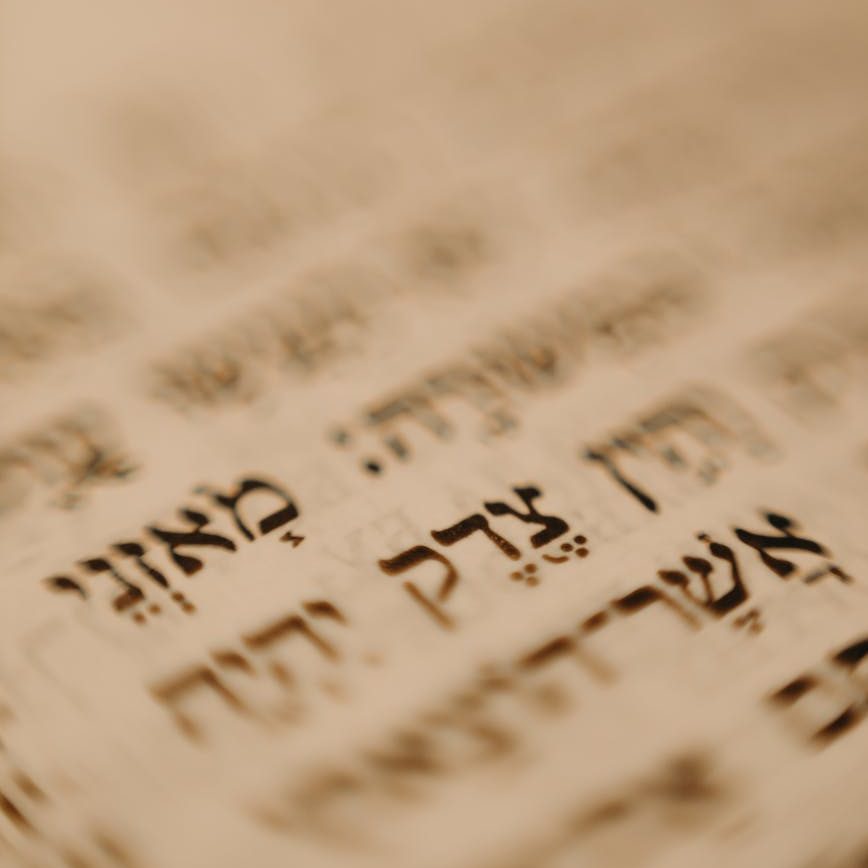
I was in conversation with someone about how we understand God. More specifically, that for some people, getting God’s name ‘right’ according to the Hebrew language of the Bible seems to be the essential way to worship.
For the follower of Christ Jesus – Yeshua, the Messiah, we understand that the holy Bible was written mostly in Hebrew in the ‘Old Testament’ (the ‘TaNaKh’ to religious Jews), and in Greek in the New Testament. We understand that the name of our Lord and Saviour is transliterated from the Greek, Iēsous (ησοῦς) Christos (Χρίστος) into English, and that the Greek is transliterated from the Hebrew. I am not a scholar of languages (the accessibility of study tools and scholarly commentaries help a great deal). I am addressing this matter because there is a deception at play which leads people astray from the simplicity of devotion to Christ.
The deception is this:- a religious movement of groups – generally labelled as ‘sacred name’ groups, that claim to have the exact, correctly pronounced name of God in Hebrew, and therefore other forms of God’s name as normally understood in Christianity are pagan. This has resulted in those who are sincere worshippers of God being distracted from the essence of our worship, into a form of legalism and error.
Let’s just get to one particular example of a ‘sacred name’ group – ‘Family of Messiah’ who are online. The Family of Messiah started through a married couple in the USA. Their story is stated on their website. They wrote “In 1992, Ruth found a copy of the Torah at the public library, and we started keeping the Sabbath day. Then, the Almighty led us and made a great way for us to go to Israel in 1995 for the Festival of Sukkot (Booths). We then started going to a Messianic congregation in Mt. Pleasant, South Carolina.” Up to this point, there was no clear indicator whether this husband and wife had been trusting in Christ as their Saviour. Their story continues…
“A major change came in 2004. The first part of the year was amazing for what He gave us. Through dreams and visions and His word, He has given us everything in this ministry of His! Even the name Family of Messiah, He gave to Ruth in prayer. He gave us a staff. It was light blue, like the sky or heavens, for blessing, and the last 8-10 inches was black for judgment. Then, He gave us prayer shawls for the women to wear in prayer, as the men already wore tallits. Then, He gave us a flag and a banner to represent our assembly, and we had them made to match what He showed us. In late November (or early December), He revealed His Name YAHUAH and YahuShuah to us! Why, we were so excited! And this changed everything! Then Ruth went to Him in prayer and heard it pronounced three times. “YAHUAH! YAHUAH! YAHUAH!” …We now had to let go of the names Jesus Christ and Yeshua. Then, later on ‘lord’ and ‘god’ had to leave our vocabulary as well.”
Some things to point out here. 1. It seems to be the wife, Ruth, leading these spiritual ‘progressions’. Where was the husband’s leadership input and guidance? 2. Receiving the name ‘Yahuah’ led to them rejecting the names Jesus Christ/Yeshua. This is the fruit of their claimed revelations of the divine name.
Let’s consider some Biblically based responses that are needed.
Firstly, what did the actual Founder of the Christian faith say about how we are to worship the Creator?
But the hour is coming, and now is, when the true worshipers will worship the Father in spirit and truth; for the Father is seeking such to worship Him. God is Spirit, and those who worship Him must worship in spirit and truth.”
John 4:23-24, words of Christ, Holy Bible
So, the first point is that our worship of the one true God must be ‘in spirit and truth’ – a spiritual connection with God according to the essence of His nature – who He is, based on truth – the ultimate reality as revealed in the Bible. Not based on getting our rituals exactly perfected, or what any man says we should do, but what the Lord Himself has prescribed! The Lord Jesus described Himself as ‘the Truth’. He is the Source of ultimate reality. He didn’t say that truth is found in getting the pronunciation of the name of God in Hebrew in an exact form.
Secondly, names matter in the sense that names relate to our personhood and often carry meanings. Parents name their children based on something that is meaningful. God gives names to people, as we find in the holy scriptures. The name of God is related to revealing who He is in essence and character. When Moses encountered the presence of God in that burning bush scenario, he asked who he should say God is, when being sent to his fellow Hebrew people. This is the response:-
And God said to Moses, “I AM WHO I AM”; And He said, “Thus you shall say to the children of Israel, I AM has sent me to you.’ ”
Exodus 3:14, holy Bible
What was the Creator meaning then? The word translated into the phrase ‘I Am’ indicates ‘be’ in a basic sense in this context. So, the response to Moses can be understood in general as “I exist, the eternal One'”. This is indicating that God has no beginning or end, therefore is a limitless Being. This would compare with the gods of the Egyptians, which this one true God was going to deal with in His judgements.
Thirdly (and these points are not in order of importance or lesser importance), there is the etymology of the name that God did reveal. God’s name was written as YHWH or YHVH יְהוָֺה . Vowels were not used in the ancient written language. In the Hebrew religious context, at some point in history, God’s name was not expected to be actually pronounced, perhaps to ensure it was not used irreverently by accident. So a title of respect was given to God instead – Adonai (meaning ‘my Lord’) and Elohim (which also has other uses not just in reference to the Creator God). Due to vowels being added to the name of God later to help with pronunciation, Biblical scholars came to either understand this as YeHoWaH/YeHoVaH or YaHWeH. ‘Jehovah’ came about later in certain Bible versions, as an English form from Latin. The point being, Bible scholars have not been 100% certain of the exact pronunciation from YHWH/YHVH. See here for a helpful article on this.
Fourth, how did the Lord Jesus address this matter of the name of God? What guidance do we get from the Lord of our salvation as written in the holy Bible? What did the Saviour teach us about addressing Him in prayer? Interestingly, He taught us to say ‘Father’. He also at times, when teaching His disciples, referred to Himself as their ‘Lord’ (‘kurios’/’kyrios’ in the Greek translated from). We can deduce from this that using the terms ‘Father’ and ‘Lord’ are perfectly acceptable terms of use. Another point is that the Lord Jesus would have known, having been born and raised in a Jewish family in His miraculous incarnation, that religious Jews did not pronounce the exact name of God from the original YHWH/YHVH. Therefore, if he had violated this practice in the presence of religious Jews, they would have been offended with Him misusing the name of God. Yet we find no indication of this happening in any of the Gospel accounts. The religious leaders were offended with Jesus addressing God as Father, indicating an intimate relationship, making Himself ‘equal with God’. Nowhere does it indicate that Jesus used strictly YHWH in front of others.
All of the points above have implications for the validity of the ‘sacred name’ groups and those who are sincere believers in Christ being deceived by this matter. We have no Biblical teaching from the Lord Jesus and His apostles that we must call Him or the Father strictly a specific word. Scholarly Biblical research has generally concluded on YaHWeH or YeHoVaH as acceptable pronunciations of the Hebrew name in general, which also have slight variations in different language contexts and in how the vowels in between are added for pronunciation. It is certainly not a basis for validating our salvation.
So how should we respond to anyone insisting on a different form of the name (Yahuah etc) and insisting the different form is the exclusive correct one? This should be rejected by followers of Christ. There is no evidence for ‘Yahuah’ being in accordance with what has been understood about the name of God.
It is understood by Biblical scholars that ‘Yeshua’ is an acceptable form of the Hebrew word. It is also understood by Biblical scholars that the English transliterations from the Greek – Jesus Christ, are perfectly acceptable forms. Many followers of Christ have experienced peace and healing in that wonderful name, and in whatever translations of the name it comes in according to where they are in the world! (In contrast to Islam, which has an insistence that Arabic must be viewed as the exclusive valid language by many non-Arabic speaking muslims around the world.)
One must consider the implications of these ideologies that insist we should only address our Creator in a claimed form that deviates from the Hebrew. This is despite the Biblically stated fact that it was God Himself who caused the people building the tower to be scattered into different languages. He did this in judgement on the idolatry of those people, but He did not then go on to reject those who began to seek Him because they now had a different language. This would be inconsistent with His character as Redeemer. In fact, this same Creator God, on the day of Pentecost, a festival observance known as Shavuot to Jewish people, actually used language as a sign of unity of His people. The language of the Holy Spirit who was poured out on the early followers of Christ, caused each one to speak in different languages as enabled by Him, to draw people to His kingdom. The visiting Jews in Jerusalem for the festival heard those Christ-followers speaking in their own regional languages by the power of the Spirit of God! How does the sacred name movement fit with that wonderful truth?
To summarise the point:- our Saviour God is more concerned about giving sinners redemption than whether we are able to pronounce His name properly in Hebrew.
So does that mean how we address God doesn’t matter at all? No. We should have reverence for our Maker… but there’s a difference between reverence and legalism (or worse still, doctrines of demons). If anyone suggests that we can’t truly respect God if we don’t use the right name (even though the supposed right name is wrongly interpreted), then they have not grasped the words of our Lord Jesus about true worship. Also, if the supposed right name results in a rejection of what is actually Biblically acceptable, we are on dangerous ground. As shown from the example of ‘Family of Messiah’, a rejection of being allowed to call the Saviour ‘Jesus Christ’ is the bad fruit, and therefore it means we could end up praying to a deceiving spirit.
 Truth Prevails